I am a Digital Designer (cand.it), educated from Aarhus University in the summer of 2023. Currently I work as a e-commerce manager and store manager at no78.dk.
My interests and research are mainly about user experience, interface design, health technologies and public data conception. With my education I have gained the strengths of analyzing data, being the intermediary between the user and the software-programmers, understanding and practicing HCI,  service-, strategic, UX-, UI- and interfacedesigns and finally obtaining a technical understanding and execution of coding.
This webside functions as my portfolio, which exhibits a selection of my favorite projects throughout my bachelor and master degree. Have fun exploring my page 😊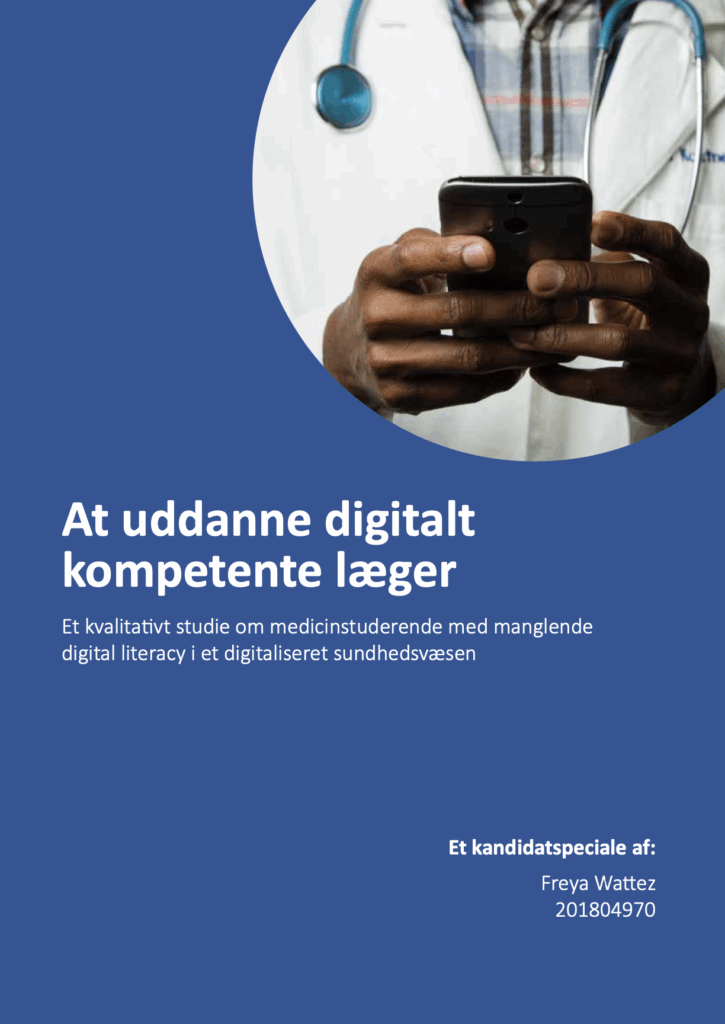
Master Thesis: Educating digitally competent doctors
A qualitative study on medical students with a lack of digital literacy in a digitalized healthcare system
In accordance with the society being digitalized in Denmark, the health care system has become more digital. The issue of this situation is the fact that the education of health professionals in Denmark is not developing at the same pace. This topic is important in the field of technology studies, as there are several consequences with the lack of digital literacy. The datafication did not only occur in the health care system as the individuals too have undergone a paradigm shift and thereby affected the societal level. The identified gap in research is thus the lack of digital literacy education in medical school at bachelor and master level.
My master thesis aims at investigating to what extent the Danish medical students are educated to be digitally competent doctors who fulfill the seven medical competencies and are equipped for the digital development of the healthcare sector, and how these competencies can be optimized and adapted to this development. For researching this phenomena a qualitative, semi structured interview approach was chosen in order to interview five medical students and one expert on the topic.
The key findings of this paper are following: (1) Danish medical students receive minimal to none education on digital competencies, (2) the informants do not feel equipped to use digital technologies, (3) all informants recognize the need to become more educated in health technology and (4) the digital competencies must contain four kinds of digital literacies: system technical literacy, personal data literacy, critical technology literacy and sociological literacy.
This paper contributes to an educational and professional discussion about the lack of correlation between the concept of digitalization and digital literacy. Furthermore it contributes with questioning the role of future educational needs, as the present situation in health care appear to be teams of digital illiterate health professionals.
Internship at Nova Møbler / No78
During the 3rd semester of the master programme, I did an internship in a company with the aim of gaining practical experience with tasks related to Digital Design. I chose to intern the same company where I am currently the store manager, as there were several tasks to be explored.
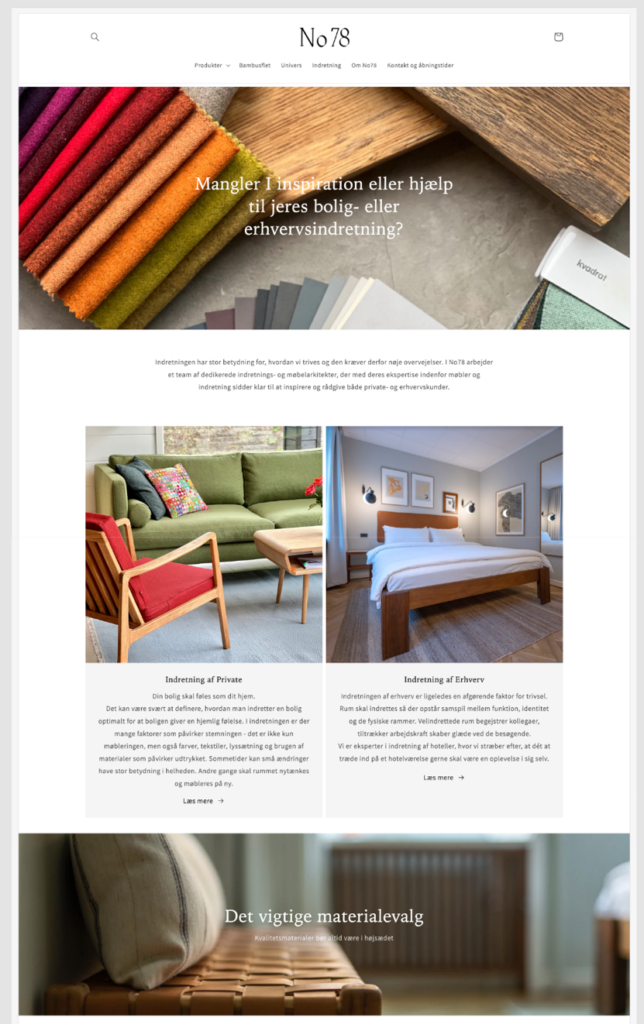
The company Nova Møbler was at that time very interested in changing their brand-name, as the brand made a significantly change in their business model for the past two years – from B2C to B2B. In 2020 after Covid19 paused all in-store-sale, the revenue decreased, which led to experimenting with a business model determent at B2B costumers. Today No78 furnishes hotels with 200+ rooms, restaurants and other businesses.
Thus I chose to spend four months planning, researching and executing a strategic restructuring of the brand, which resulted in a new name (No78), a new website and a new perspective of the enterprise. The new identity can be viewed on the link below.
In summary, this strategic reorganization of Nova Møbler to No78 is a very time-consuming process, which is far from finished – even though the website now appears established. Rearranging one’s identity is also about evolution, and it must be maintained. This entails many basic elements that also need to be better structured, so that the customer gets the best possible buying experience in No78.
Bachelor Project : creating an extension to Face2Gene
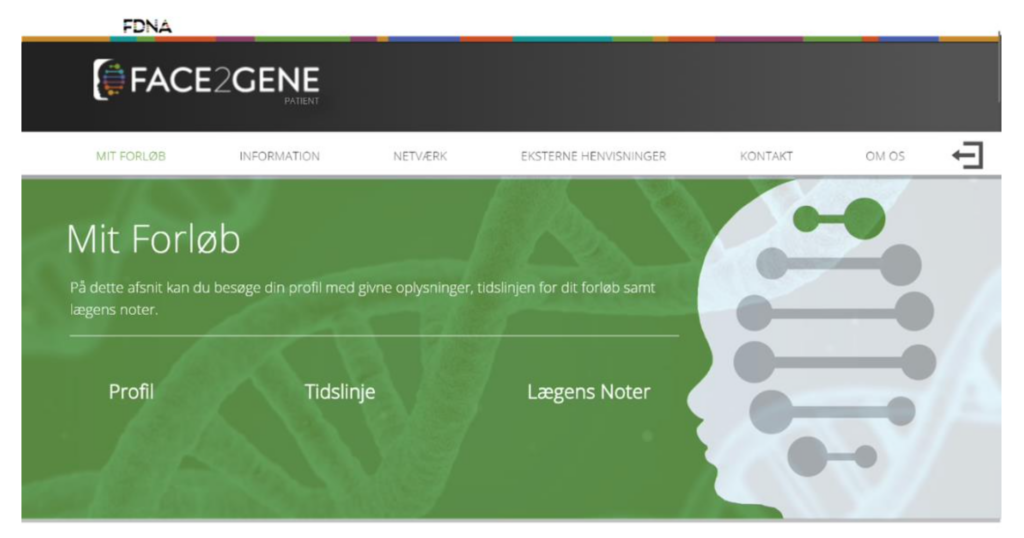
I wrote my BA-thesis in collaboration with two of my fellow students, in which we explored the health technology Face2Gene. Face2Gene is a groundbreaking tool in medical genetic evaluation. Via an algorithm powered by artificial intelligence the individual face is analysed, and the software enables the doctors to detect genetic diseases.
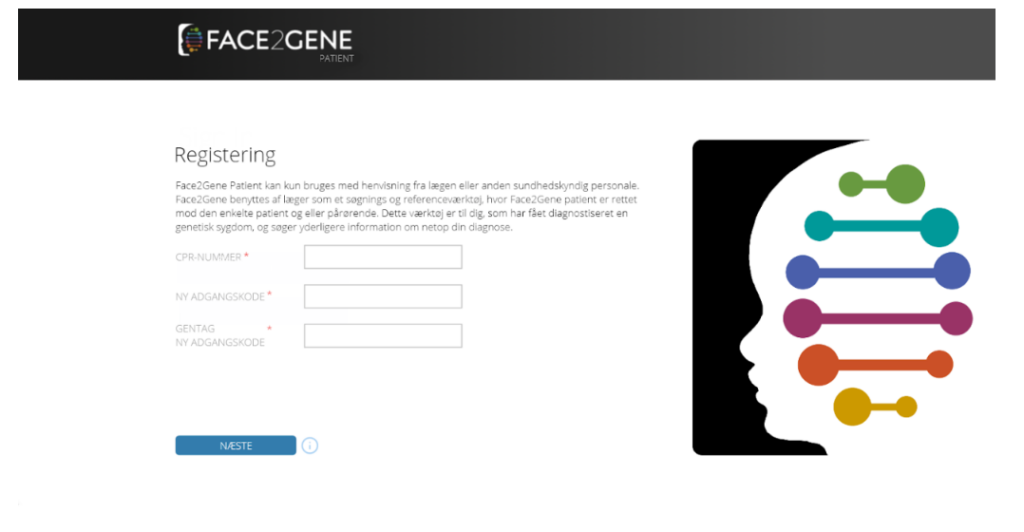
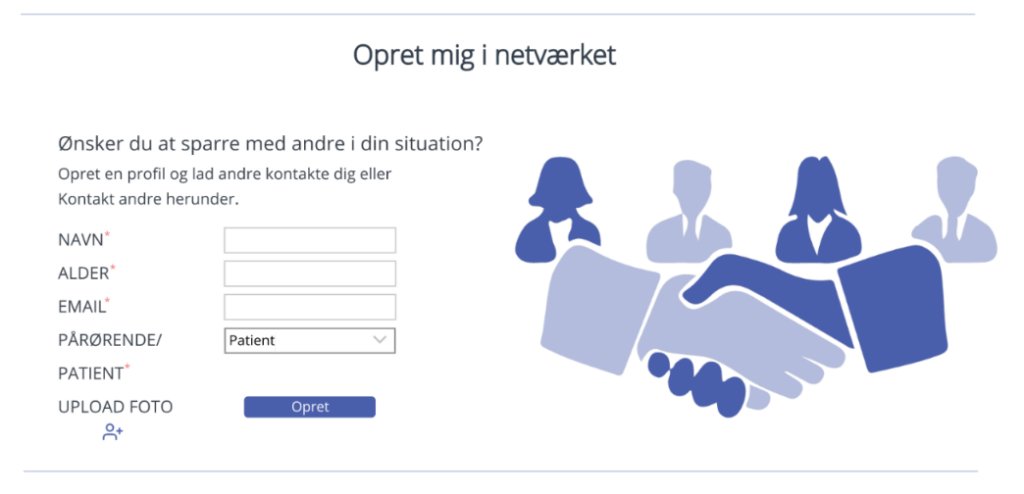
In order to further develop and improve the diagnostics and treatment both patients and doctors are looking for means to network. On the basis of Digital Design including interface theory, Social Computing as well as algorithms, our purpose was to accommodate this demand. As a result of this insight, we developed a programme called Face2Gene Patient.
Based on the method of Design Thinking, we have developed Face2Gene Patient as an extension to the existing interface Face2Gene. The difference is that Face2Gene Patient has been developed with the patient/the next of kin as the primary target group, which is why the many functions on Face2Gene have been cut out so that only the most important information is passed on to the patient/next of kin. Face2Gene Patient is both personal and individualized. Personal, as it is targeted to a certain target audience; especially people in contact with genetic diseases. Individualized, as the software is adapted to the course of each individual through their danish CPR.
The thesis statement is investigating how Social Computing can contribute to Face2Gene as a personalized and individualized interface as a closed and safe environment for communication. Through this social network genetic diagnosed patients and relatives can benefit and receive feedback and support during difficult times.
Sustainable Grocery Shopping
In the following project, Sustainable Grocery Shopping is given as a starting point, where food waste is selected as a focus area. Food waste is the biggest climate burden in the value chain, where grocery stores cause 8-10% of all CO2 emissions annually, which is why Salling Group works ambitiously to reduce food waste.
Design as a creative and innovative element and strategy as planning for an end goal must be combined in a partnership at Salling Group, in order to successfully reduce food waste in the grocery business. Design and strategy are two contrasting fields which previously did not have much collaboration, but which should be merged going forward in order to lead a company to development and ultimately increase added value. At the presentation, Sustainable Grocery Shopping was given as a starting point, where food waste was selected as a focus area.
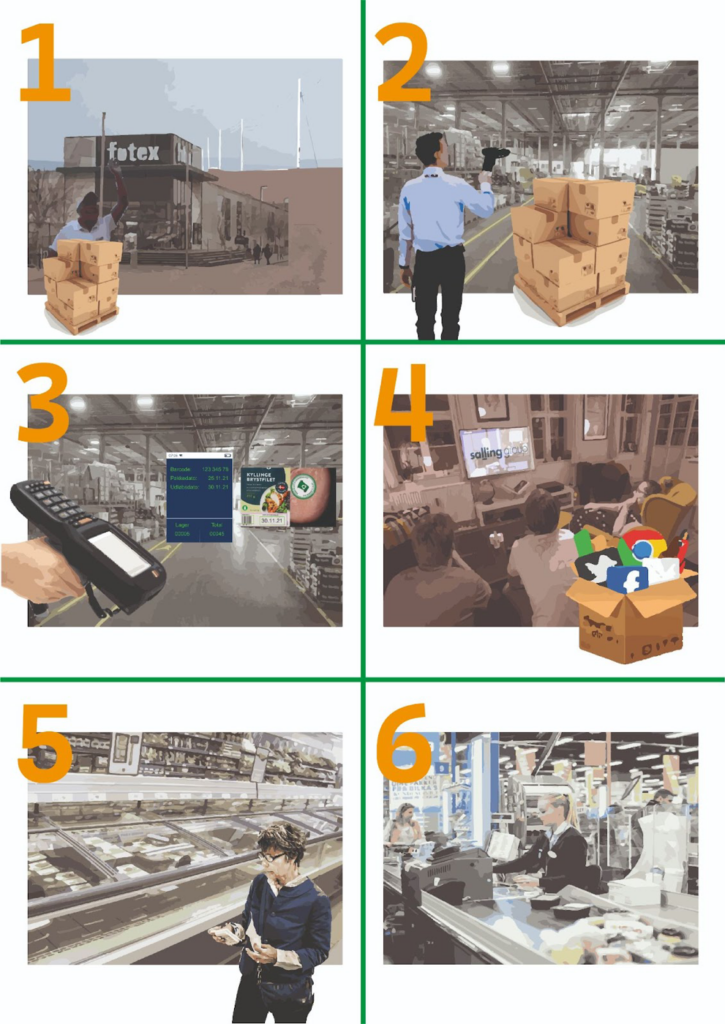
We had prepared a design solution where the yellow stickers on products in a supermarket become digitized; an automatic price adjustment of products with short expiration date. This was performed with an active use of the business canvas model. How this is strategic design, and why exactly these two fields must be merged, was our task of investigation, which we performed by answering the problem formulation below:
How can strategic design contribute to solving wicked problems in the form of food waste?
Datafication of Refugees
With the emergence of digitalization all around the world, the context for the refugees is rapidly changing, as they are becoming objects for datafication. Satellite tracking systems, biometric scans, human detector sensors, drones and other smart technologies are emerging apace, making the refugees body into a series of data which define the person’s digital subject and thereby the rights. This data is sensitive for the individual, which of course makes it data-limited for the public. Furthermore, there is not much data from the different surveillance either – no datasets based on the generated data and no clear overview upon how the systems specifically measure the refugees.
“Through these biometric procedures, the refugee body becomes abstracted and broken down into a series of data which then define the person’s legitimacy and right to access vital services”
B. Ajana, 2020
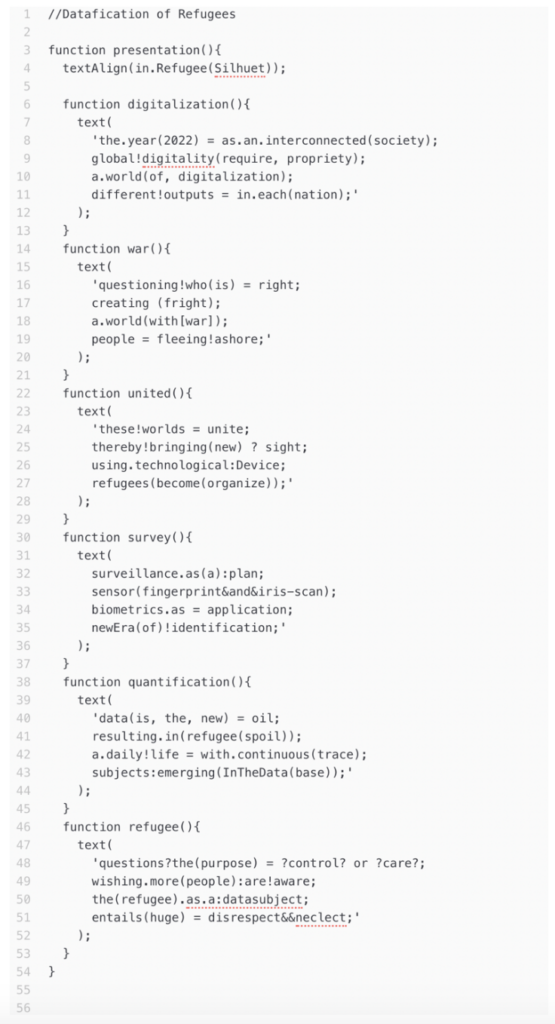
I tried to visualize how a refugee body has become less human and more a digital subject. Although I found it a bit vague, which is why I tried to incorporate poetic dimensions into the situation – an elegant and abstract course of action to describe a vulnerable situation. With this intention and with the knowledge gained from the information of my first sketches, I created a codework.
The codework is written in JavaScript coding language, in which the different functions have been altered, the strict punctuation is up for debate, and the executability is not possible. Thus the created code cannot be executed, but the code itself tells the story – here the codework is the image of visualization.
I concluded this project with stating that; The refugees have become digital subjects, the borders go beyond physical spatiality and the refugee crisis is now a profitable business.
Curating Data Project
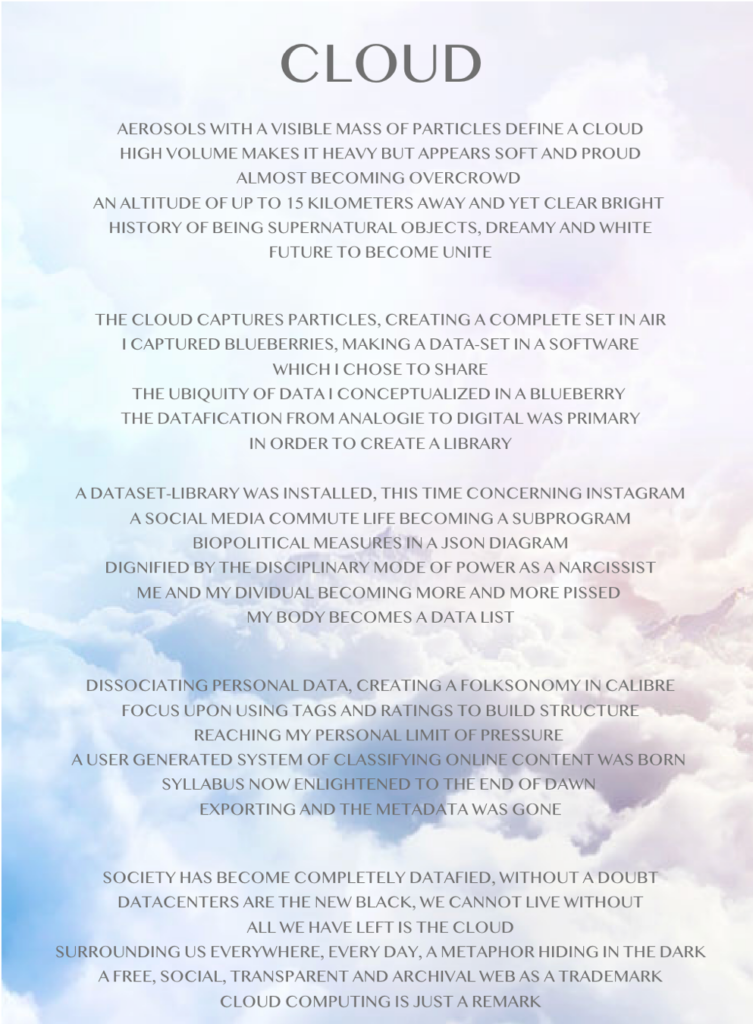
In the course of Critical Data Studies I was introduced to a smaller course called Curating Data. Throughout the course we were assigned four tasks, which concerned (1) making a dataset, (2) making a data selfie, (3) the creation of a folksonomy in Calibre and (4) presenting a curational statement. The last assignment we were asked to bring all of these four elements together in one statement. Here I chose to present the curatorial statement in the shape of an interactive, beautiful and carefree poem concerning clouds, data and the ignorance of datafication.
The cloud has become an illusion, and yet a satisfiable metaphor for the narcissistic tendencies in the society. This is enlightened in the curatorial statement, where I, as the poet behind, put myself up on a pedestal, playing with a divine aspect in the beautiful clouds. Here I am stating, that the society does not have knowledge of the real cloud, as they only think about themselves. Concluding that the last verse sums up my curatorial statement; “Cloud Computing is just a remark” – which is problematic in many ways.
Viewing the poem called Cloud, you immediately comprehend that it concerns clouds – not only due to the title but also due to the background, which visualizes a romantic atmosphere surrounding clouds in the nuances of blue, pink and white. Looking at the poem it exhibits static, but nevertheless the poetry, especially in stanza 2, 3, 4 and on the first three verse in stanza 5 appears dynamic when performed.
Between each slide and each stanza you can press ‘enter’, as the software then reacts with executing the following instructions I have given. You cannot press enter in order to speed up the process, as you have to await the other assigned tasks to be fulfilled first. The interactive aspects of the poem can be viewed below on the following link:
Wanna say Hi?
I’m always eager to chat with other designers, developers or companies. Whether it’s about an upcoming project, a potentiel collaboration, a job or just to say hello, feel free to write me an email.